
Commercial and industrial solar has already helped businesses solve one major problem:
The cost of electricity generation.
For years, C&I solar was mainly viewed as a way to reduce grid dependency and bring down electricity bills through daytime solar generation.
That logic still holds strong.
But the energy needs of businesses are changing.
Factories do not operate only when the sun is shining.
Cold storage facilities run throughout the day and night.
Commercial buildings often have evening loads.
Industrial machines create sudden demand spikes.
Power interruptions can disturb production, safety and service commitments.
So the next challenge for C&I solar is not only generation.
It is timing.
The real question is no longer just:
“How much solar power can we generate?”
The better question is:
“Can we use that solar power when it matters most?”
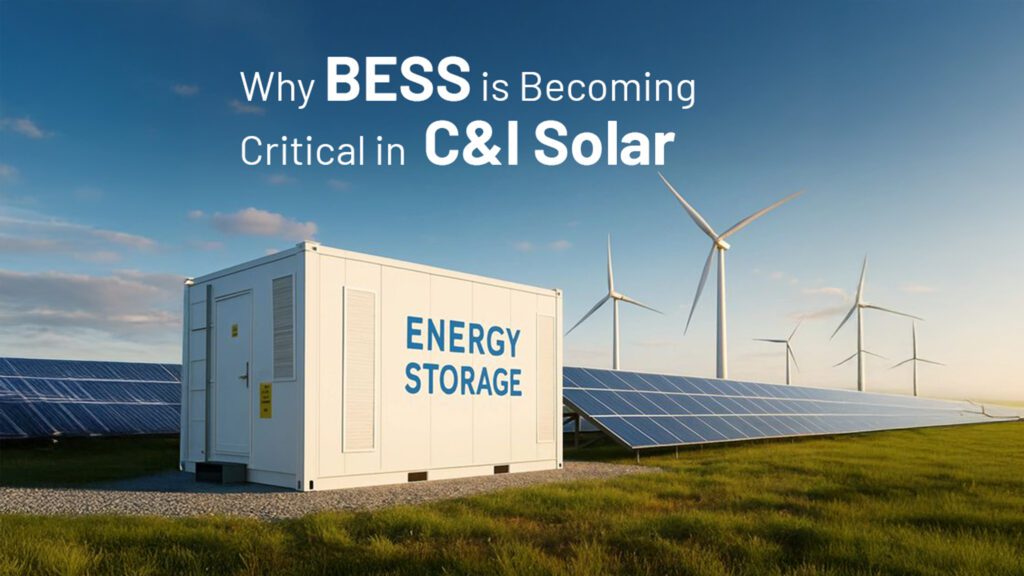
That is why Battery Energy Storage Systems, or BESS, are becoming critical in C&I solar.
Solar generation and business consumption do not always match
Solar power is strongest during the day.
But many commercial and industrial businesses consume significant electricity beyond solar hours.
A factory may have evening production.
A hospital may need reliable power at all times.
A cold storage unit cannot afford interruptions.
A warehouse may have extended operating hours.
A manufacturing plant may face sudden load peaks during equipment start-up.
This creates a clear mismatch.
Solar generates energy during the day, but the business may need a large part of its energy later.
Without storage, solar energy has limited flexibility. It must either be consumed immediately, exported where permitted, or underutilised.
With BESS, daytime solar power can be stored and used later.
That one change makes solar more useful.
It shifts solar from being only a generation asset to becoming part of a larger energy management system.
Why this matters more now
India’s solar capacity is growing rapidly. As of 30 April 2026, India’s cumulative installed solar power capacity reached around 154.23 GW, according to MNRE’s physical progress data.
This growth is good for the country and good for businesses.
But as solar becomes a larger part of the power system, flexibility becomes more important.
The Government of India’s Time-of-Day tariff framework also makes this shift more relevant for commercial and industrial consumers. Under this framework, peak-period tariffs for commercial and industrial consumers shall not be less than 1.20 times the normal tariff, while tariffs during solar hours shall be at least 20% lower than normal tariffs for that category.
This means the same unit of electricity may not have the same value throughout the day.
Power consumed during a peak period can be more expensive.
Power available during solar hours can be cheaper.
For businesses, this changes the economics of energy.
The opportunity is no longer only to generate cheaper electricity.
The opportunity is to store energy when it is available and use it when it is more valuable.
That is the commercial logic of BESS.
What BESS does in a C&I solar system
A Battery Energy Storage System stores electricity and makes it available when the business needs it most.
In a C&I solar system, this usually means storing daytime solar power and using it later – during evening loads, peak demand periods, grid interruptions or critical operating hours.
This is important because many businesses do not consume electricity only during solar generation hours. A factory may have extended production shifts. A cold storage facility may need continuous power. A commercial building may see higher load in the evening. A manufacturing unit may face sudden demand spikes when machines start.
In these situations, BESS adds flexibility to the solar system.
It can help businesses improve solar self-consumption, reduce sudden grid draw, support critical loads, manage peak-period consumption and prepare better for Time-of-Day tariff structures.
Many people still think of batteries only as backup.
But in C&I solar, backup is only one use case.
The larger value of BESS is energy control.
For a C&I consumer, energy cost is not only about how many units are consumed. It is also about when those units are consumed, how stable the power supply is, and how much the business depends on the grid during critical operating periods.
BESS helps businesses manage these factors more intelligently.
The biggest benefit is simple:
BESS gives businesses more control over when energy is used.
And in the next phase of C&I solar, that control is becoming increasingly valuable.
Why hybrid inverters matter
A battery alone does not create a smart energy system.
The system needs proper power flow management between:
Solar
Battery
Grid
Load
This is where hybrid inverters become important.
In a solar + BESS system, the inverter is not only converting power.
It is helping manage energy movement.
When should the battery charge?
When should it discharge?
When should solar directly serve the load?
When should the grid support the system?
These decisions affect performance, savings, reliability and long-term system value.
For C&I customers, this means the quality of the inverter and the quality of system design become extremely important.
As solar systems evolve, the inverter is no longer just a conversion device.
It becomes the energy flow manager.
Who should seriously consider BESS?
BESS may not be required in the same way for every site.
But it should be seriously evaluated by businesses that have:
-High evening or night consumption.
-High peak demand.
-Expensive grid power during certain hours.
-Unreliable power supply.
-Critical loads.
-Cold storage or continuous operations.
-Large rooftop solar capacity.
-Expansion plans.
-Interest in future-ready energy management.
This is important because BESS should not be sold as a generic add-on.
It should be designed around the actual load profile, tariff structure, backup requirement and business objective of the site.
The right question is not:
“Do we need a battery?”
The right question is:
“Where does storage create measurable value in this energy system?”
India’s storage requirement is also growing
The need for storage is not limited to individual businesses.
At the national level too, energy storage is becoming important for renewable energy integration.
As per the National Electricity Plan projections cited by the Government of India, India’s energy storage requirement is projected at 82.37 GWh by 2026–27, including 34.72 GWh from BESS. By 2031–32, the total storage requirement is projected to increase to 411.4 GWh, including 236.22 GWh from BESS.
Globally, battery storage is also scaling fast. The International Energy Agency reported that 108 GW of new battery storage capacity was deployed worldwide in 2025, which was 40% more than in 2024.
These numbers show a clear direction.
Storage is moving from future discussion to practical energy infrastructure.
For C&I solar, this means businesses should start preparing for solar systems that are not only generation-ready, but storage-ready and control-ready.
The future of C&I solar is solar + storage + control
The first phase of C&I solar was about generation.
The next phase is about intelligent energy use.
Businesses will continue to install solar because it reduces electricity cost and supports sustainability goals.
But as power tariffs, demand patterns and reliability needs become more dynamic, solar alone may not be enough for every site.
BESS adds flexibility.
Hybrid inverters add control.
Together, they help businesses use solar power more intelligently.
For commercial and industrial customers, this means better readiness for Time-of-Day tariffs, peak demand pressure, power reliability needs and future expansion.
For EPCs and installers, it means a stronger opportunity to move from selling solar systems to designing complete energy solutions.
How Feston supports the next phase of C&I solar
As C&I solar evolves, businesses and installers will need solutions that bring solar generation, battery storage and intelligent power management together.
This is where Feston’s focus on hybrid inverter and BESS-ready solutions becomes relevant.
The future of solar performance will not be measured only by how much energy is generated.
It will also be measured by how intelligently that energy is stored, managed and used.
For C&I businesses, storage is becoming a strategic layer.
For installers and EPCs, it is becoming an important solution opportunity.
For India’s solar market, it is becoming part of the next growth phase.
With Feston, Always On.
Planning a C&I solar project with storage?
Talk to Feston’s team to explore hybrid inverter and BESS-ready solutions for commercial and industrial solar applications.
Whether you are an installer, EPC, consultant or C&I customer, the next phase of solar will need more than generation.
It will need storage, intelligence and control.
With Feston, Always On.
FAQ
- Why is BESS important for C&I solar?
BESS is important for C&I solar because it allows businesses to store solar energy and use it when required. This helps improve solar self-consumption, support peak demand management, improve reliability and prepare for Time-of-Day tariff structures.
- How does BESS improve solar value for businesses?
BESS improves solar value by allowing daytime solar power to be stored and used later. This can help businesses use solar energy during evening loads, peak tariff periods, grid interruptions or critical operating hours.
- Is BESS useful only for backup?
No. Backup is only one use case. In C&I solar, BESS can also support peak shaving, energy time-shifting, solar self-consumption, tariff optimisation and energy reliability.
- What is the role of a hybrid inverter in a solar + BESS system?
A hybrid inverter manages power flow between solar, battery, grid and load. It helps decide when the battery should charge, discharge or support the connected load.
- Which businesses should consider BESS?
Businesses with high evening or night loads, high peak demand, unreliable power supply, critical operations, cold storage, large rooftop solar capacity or future expansion plans should evaluate BESS.